Jun 21, 2013

AM Portrait: Time

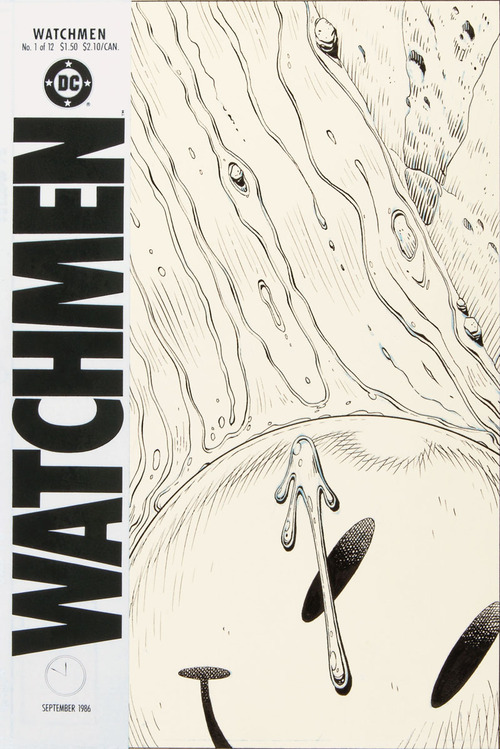
Watchmen N.1: original cover art by Dave Gibbons.
In 2003, internationally acclaimed Italian comics author IGORT wrote an article for the Alan Moore: Portrait of an Extraordinary Gentleman book (Abiogenesis Press, page 179). It was an interesting analysis of Moore's comics writing approach. You can read it in the following.

Posted here with the author's permission.
You can read an interview with Igort - in English - here. 

Time
© Igort 

Paris, late March, 2003
Earlier today I met a fellow artist, Oscar Zarate. As usually happens between authors, we talked about work over a cup of tea. You know, the things we are currently doing, those we are planning to do, our personal opinions of a certain publisher, the comics world in general. Very soon the conversation turned to an old piece of work done by Oscar and Alan Moore. Inevitably, I asked how it had felt to provide the art for A Small Killing, since I know Alan’s scripts are extremely dense and packed with information. In this respect, Moore is not just famous, but legendary. To an artist, manoeuvring through thousands of details is never easy. “Usually with Alan, a panel takes up a whole page of the script with explanations”, Oscar told Sampayo, who was sipping a Russian Earl Grey with us. These descriptions are quite precise and very visually oriented. Oscar said he had had no problems: the two of them had co-written the story and thus, for once, Moore did not need to resort to his minutiae, panel after panel, page after page.

Flashback
I recall my first impressions after reading Watchmen. It was the late Eighties. I had just founded a magazine called Dolce Vita and wanted to publish quality European comics; not just the same old stuff, but comics which would add something new to the medium. A few years earlier, along with Lorenzo Mattotti, Giorgio Carpinteri and others, I had co-founded what came to be known as the “Italian comics new-wave movement.” It was a group of authors producing their own magazine, Valvoline Motorcomics. We were convinced that making the most of the medium’s enormous potential and working on the language was the natural thing to do. We acted like a Surrealist group, with a mix of irreverence and irony which used to incense a part of Italian comicdom, especially the more conservative among our colleagues. After the Valvoline experience, then, I was finding myself again in the dual role of author and publisher. Watchmen struck me deeply because it was an extremely complex and multi-layered work, which had no use for the narrative shortcuts of American mainstream comics. The characters wore spandex, true, but could anyone call them “heroes?” Moore was ruthless with them. He completely rewrote the American myth from a European point of view. Moreover, Watchmen was a true epic: it took hours to read and on reaching the last page, one felt it was necessary to read it again and again to appreciate all its subtleties.

Another thing I admired in Moore was his mimetic ability to use mainstream tools to produce something different. In this case, the tool was the comic book format, which Moore was using as a feuilleton, as if he were a 19th Century French writer. To him, each issue was a chapter of a story that was much greater than the sum of its parts. The covers themselves were unusual in that they worked by subtraction: action was no longer in the foreground, replaced by a metaphysical look on objects which acted as traces, as memories of actions which had already taken place. Moore would also work with time, taking a step back and letting it do its job on people and things. To me, time was the true main character in the story. Fifteen years later, my opinion is still the same and I think it applies to all of Alan’s works. What I admire in them is the absence of boundaries. Comics are not the only thing Moore reads and this shows in the way he conceives the story. This stems from an extremely broad notion of storytelling. Watchmen is full of stories which contain other stories, just like Russian dolls.

It is a many-voiced narrative, but at the same time also a meta-narrative, a sum of different techniques (documents, letters, newspaper clippings, etc.). From this point of view, it is the closest thing to avant-garde art in the field of comics.
V for Vendetta #7 Chapter 13, page 1. Art by David Lloyd.
Paris, April 1st, 2003
I would like to stress that to me the importance of Moore’s work lies not only in his use of different storytelling techniques, but also in the fact that this is done subtly and unobtrusively. He is first and foremost a great narrator. The reason why I wanted to write this homage to him is because I consider works such as Watchmen or V for Vendetta (to name just two) still perfectly relevant. They marked a watershed in the history of storytelling in the last twenty years. Unlike other books that came out more or less at the same time and today look mostly to have aged badly, Alan’s works are still un-aged and ageless.

Flashback – Bologna, 1987
Alan’s stories – and this happens very rarely otherwise – can be the subject of a narrative themselves. I recall a conversation with Giorgio Lavagna (a fellow writer and the singer in a band in the glory days of Italian New Wave) in which, lost in reverie, he waxed lyrical about the Miracleman book. He told me how Moore had retrieved a forgotten minor-league hero and rewritten his history. Pages from the original series, which had been cancelled many years before, were even used as part of the new stories and given a new life. The difference in style was justified by the plot which, if I remember rightly, involved moving between dimensions. Ever the great talker, Giorgio told me and Leila [Marzocchi] about the mechanics of the story, down to the personal details, while mimicking the characters’ stances, facial expressions and hesitations.

This had an incredible effect on me and I remember I started looking everywhere for those hard-to-find back issues.
Well, I find Moore’s ability to astonish even other writers, to have this effect which transcends the boundaries of both one’s nation and one’s ego, one of his most amazing traits. In my view, being able to pass on this great passion for narrative – for the act of telling itself – really means a lot.

In retrospect, even the blurbs on the back cover of the original paperback collection of Watchmen seem to have aged faster than the book itself. Time Zone Magazine described it as “the first true postmodernist superhero comic-book,” Time Out as “a true novel.” Today, these definitions sound inadequate. Dealing with an author who defies classification by creating categories of his own, they look like some garment one retrieves from a chest after fifteen years, wondering: “How on Earth was I able to squeeze into this?”

Paris

Jun 15, 2013

AM Portrait: The Magician

Alan Moore portrait by PetaloMaM
In 2003, Italian writer and artist Marcello Albano contributed to Alan Moore: Portrait of an Extraordinary Gentleman book (Abiogenesis Press, page 125) with an interesting short text. You can read it in the following. 
Special thanks to the author for the permission to post the piece on this blog. 
 
The Magician
© Marcello Albano

It’s very difficult for someone who works in the comics field to talk about Alan Moore.
For two reasons: the first one is that the Northampton-based magician is the BEST writer who has ever graced the medium. The second reason is that Alan is, maybe, the ONLY comics writer in the world.

Writing comics is not a real job. People who do it often have a degree in the Humanities and aspire to write for television, cinema, web sites and magazines, if they do not nourish the dream to write the Big Novel. Comics are just a small part of their literary interests.
They are often so busy trying to avoid the “expressive restraints” of the comics page, that they don’t care at all to verify if these restraints are real or just the result of a prejudice.

Alan has spent his whole career doing exactly the opposite. He didn’t get any formal higher education. After having let himself be expelled from high school for dealing Acid and having lived the years of the sexual revolution in the ARRGH community, he was (for a short time) a musical journalist; since 2000 AD, the legendary British magazine, he never again left the comics medium.

Even his novel, Voice of The Fire, is a comic without pictures as his From Hell is a novel in comics form.
What I mean is that in those works there are storytelling techniques which are possible ONLY in comics: in the first case, I am referring to the first chapter, where the cavemen talk in a Neolithic English (Alan loves creating new languages; in comics the understanding of his neologisms is supported by the pictures); in the second case, on the contrary, it gives the impression of a conversation fading out, an effect made by the progressive shrinking of the lettering…

Alan explores the possibilities of comics, discovering an immense cave whose limits are clearly known only to himself. The bearded hippie is not interested in exploring other media. His discovery, apparently a simple one, is that FREEDOM OF EXPRESSION in comics is limited only by talent and by the skill of who is using it.

After having spent the first half of his career killing characters (his first issue on Captain Britain was a bang: in a four-page sequence he kills the whole cast of the series, main character included) and moving all the social criticism and odd surrealism of the “Undergrounds” into the comics mainstream. Alan took a long sabbatical and resigned from his role as minor post-modern genius. Then he came back, with general surprise, in the guise of Great Wizard and as a devotee of Crowley, Dee and Spare.

In this new phase what amazes the most is the incredible quantity of his new creations. It almost seems that he is repenting for having put the last nail in the coffin of the superhero genre, by trying to magically reanimate the corpse.
After their iconoclastic fury has vanished, Alan’s stories lose their dark and apocalyptic tone and get crowded with characters that we would never expect to meet again. Here they are, they all come back: the super-dog, the super-ape, the planet where the good guys are the bad ones and vice versa … no hero is really dead; there is no character in the imaginary realm who can do it.

Moore owns the key for the Limbo where all the untold stories have their place. It is a secret garden where aliens with two bodies run after women dressed in protective girdles and the Trojan War is still raging.

There, growing like a vine around their own story, the Knights of the Holy Grail, Supergirl, Alexander The Great and Jack The Ripper with his Mary Kelly are all living together.
You have just to evoke them and they will reply.

Obviously, to do this you need to be a magician …

Jun 7, 2013

The Comedian in Denver

Art by Farel Dalrymple
Above, a great Comedian sketch drawn by the amazing FAREL DALRYMPLE during the latest Denver Comic Con. A larger version of the picture can be seen here.

Visit Farel Dalrymple Tumblr page HERE.

Jun 2, 2013

Alan Moore talks about celebrity status

Alan Moore's portrait by Charles Burns.
The Believer: You don’t seem to be part of the convention circuit, which is how many in the comics industry try to connect to fans. But I don’t see you as particularly shy, either. 
Alan Moore: No, I’m not a very shy person. I’m just somebody who’s got a lot of work and who doesn’t like to parade himself in new celebrity contexts. So I don’t like to go to conventions, and I don’t like to relate to people on a level of hero worship, because there’s no real communication going on there. I prefer to talk to people on the same level. So, no, I’m not shy, but I am not publicity-seeking either.
[Excerpt from an interview by Peter Bebergal, available online on The Beliver site, and printed in The Believer N.99, June 2013] 

Visit here the Charles Burns: Cover portraits for The Believer 2003-2013 exhibition page. "Behind the scene" of the exhibit here.

May 31, 2013

V World

Art by César Moreno
Above, an amazing illustration - a true V for Vendetta celebration - drawn by Mexican artist César Moreno.

More details about the illustration here.

César Moreno's deviantArt page HERE.

May 28, 2013

Dr. Manhattan and Nite Owl by Franco Brambilla

Art by Franco Brambilla
In 2006, in the occasion of its 20th anniversary, I edited "Watchmen 20 anni dopo", an Italian Watchmen tribute book which was basically a collection of 12 brand new essays plus some extras. The volume was published by Lavieri with all net profits donated to AIMA, the Italian Alzheimer organization. 
Acclaimed Italian sci-fi illustrator FRANCO BRAMBILLA contributed to the volume with an amazing back-cover illustration, in his classic 3D style, featuring... Dr. Manhattan, Nite Owl and his Owl ship!

The illustration has been posted on this blog with the author's permission.
For more info about the artist visit his site: here.

"I have always loved the Nite Owl ship and contributing to this tribute has the opportunity to realise it as a 3D model. I had a lot of fun researching the references in Gibbons's panels, and building a model as close as possible to the original ship.
I hope that my illustration, a bit dark and smoky, is able to convey the atmosphere of the original graphic novel, a genuine work of genius which still remains relevant nowadays." [Franco Brambilla]
Franco Brambilla at work.

May 25, 2013

AM Portrait: Alan Moore and The Mystery of Transubstantiation

Illustration by Luís Dourado
Italian writer Giuseppe Pili contributed to the sold-out Alan Moore: Portrait of an Extraordinary Gentleman (2003, Abiogenesis Press, page 33) with a really interesting short text about Moore and... transubstantiation.

A special thank to the author for the permission to post his contribution on this blog.

Alan Moore and The Mystery of Transubstantiation
© Giuseppe Pili

When we solve a riddle or crack an enigma, our spirit is pervaded by a subtle pleasure. Are we enticed by the complexity of the enigma, by the riddle-maker’s skill, or by the confirmation of our abilities? There is no use in trying to tell these elements apart: their mutual permeation is the alchemy underlying the game.

There definitely is a difference between playing and being on the receiving end of a narrative – it depends on our degree of involvement. Listening or reading implies some passivity, while playing forces us into a direct confrontation.

We might define Moore’s stories as “ludic interactions”. Calling them “games” would be reductive: they are complex and refined challenges, which gradually screen the players. Going one step further, we could even talk of true initiations into Moore’s world. We learned that the Master does not speak to just anybody, but only to those who have the talent – or the burden – of understanding stories first with the mind and only then with the heart. Admittedly, this pleases us. The symmetries, the references, the ellipses, the paraphrases, the quotations are all part of an architecture which entices and hypnotises us. Once we get trapped inside Moore’s reality, we become its prey: we no longer understand where our everyday experience ends and his realism begins, we cannot tell a true dialogue from a simulation à la Moore.

We know the game well and we want to play it, if possible, with minimal variations. As we read the first page, the opening panel sweeps us away: the opening lines are complex and convoluted. We are bewildered, but not frightened: we know that, at the right moment, the Master will guide us. Then a structure begins to take shape. Recognisable, reassuring elements start to appear. For us, it is a relief; luckily, we are not completely at the mercy of Chaos. We have an irrational faith in the existence of an eventual Meaning and with Moore there is always a Meaning. Thus, as we keep reading, we become aware that what was originally obscure had its own justification after all. The second half of the story discloses the first and we feel the thrill. “Brilliant”… “how does he do it”… “how does he manage”… “such a balance of form”… “such daring geometry”. Our passion lights up very gradually and is incomprehensible to those who do not live inside their mind.

The ending succeeds in squaring the circle. We reassemble the pieces of the jigsaw in a moment of self-complacency. Here comes a retroactive aesthetic delight, exquisitely intellectual. We are pervaded by an unconscious and narcissistic pleasure in our abilities. We have understood Alan Moore. We have rightfully been initiated into his Church of Mysteries. Our lips have received the Host of his spirit.

Through the might and magic of this artistic transubstantiation, Alan Moore is no longer the creator of the magic. Now he has become both the magic itself and its officiants. He is part of us.

Reciprocity is the secret of his fascination: after the last page, irrespective of the man living in Northampton, Alan Moore is us.

May 23, 2013

AM Portrait: Oscar Zarate's Memories and Quarrels

Art by Oscar Zarate.
From the sold-out volume Alan Moore: Portrait of an Extraordinary Gentleman (published in 2003 by Abiogenesis Press), pp. 181-183.

In the following you can read (click on the image to enlarge) a 3 page comics short - titled Memories and Quarrels - written and drawn by acclaimed Argentinian author OSCAR ZARATE, the artist and co-creator with Moore of the wonderful A Small Killing, originally published in 1991 by VG Graphics.
It's a personal and funny tale with... a "little creep" guest appearance. And I confess it is one of my favourite contributions included in the book. So... enjoy!

Posted on this blog with the author's permission.
Memories and Quarrels. Story and art by Oscar Zarate.

May 22, 2013

Hipster Moore

Photograph by David Ma.
You’re proud of your status as a hipster. Do you regret the way it’s become a disparaging, pejorative term now?
Alan Moore: Has it? Yeah, that’s probably true. It used to be a fashion statement, but it was information as a fashion statement which is probably going to do you more good than the clothing you wear. I got an incredible education starting from the point at which I was thrown out of school. Now, I could probably hold my own intellectually with most people who have had university or college educations. And indeed some of them will have done courses on my books. So, despite the fact my ‘education’ ended at 16, I had hipsterism, which was wanting to be hip, and that led me to read this incredibly diverse array of books on science, mysticism, science fiction, literature, art… I would find out about these movements that I had heard about, and it’s given me a pretty comprehensive education. Now I am an autodidact, which is a great word… I learned it myself.

May 20, 2013

Walt Simonson reveals Rorschach's true identity

Art by Walt Simonson.
From page 93 of the Alan Moore: Portrait of an Extraordinary Gentleman book (Abiogenesis Press, 2003).

Above, you can admire an amazing and amusing illustration by Comic Art Master WALTER SIMONSON... revealing an unknown truth!

Illustration posted on this blog with the author's permission.
Visit the Simonson Wikipedia page: here.

May 19, 2013

Eric Shanower and his Little Margie

Art by Eric Shanower
From page 29 of the sold-out Alan Moore: Portrait of an Extraordinary Gentleman (Abiogenesis Press, 2003).

Above, you can admire a great illustration by acclaimed author ERIC SHANOWER, featuring Little Margie, Promethea and their companion Chinky.

The illustration has been posted on this blog with the author's permission.
For more info about Shanower visit his site: here.