
Jul 6, 2025


Jul 4, 2025
Polish Illuminations
On the upper side of the image, you can notice that they involved a lot of translators!

More info HERE.
Jul 3, 2025
Faunus n.51: Alan Moore on Machen

Faunus is the literary journal of The Friends of Arthur Machen and has appeared twice yearly since the inauguration. Contents regularly include both articles of interest to admirers of Machen and examples of his work, often articles and pieces not easily available elsewhere.
If you want to read Moore's piece you need to join The Friends: check it HERE!
***********
Alan Moore contributes essay to Faunus
June 22, 2025
We are thrilled to announce that fellow Friend Alan Moore has written an article for the latest edition of Faunus (No.51). In The View From Canons Park, Alan candidly reveals the origins of his Long London series, and why an often overlooked Arthur Machen story sits at the heart of it's first book, The Great When - (reviewed by R.B Russell, also in this edition). [...]
Faunus No.51 is already making its way to members worldwide and is limited to just 350 numbered editions. New or renewed members will receive a physical copy while stocks last, however all members will be able to download the digital version, available now in the Friends' Area.
[...]
Faunus No.51 - Second Edition (Unlimited)
July 02, 2025
Last month, we announced that Alan Moore had contributed an article for the latest edition of Faunus. This news triggered a surge in memberships and renewals, although regrettably our limited run of 350 copies was not enough to meet the demand. Not wishing to disappoint any of our new joiners, we have ordered a re-print. These Second Editions will be unlimted and issued to everyone who missed out on the hand-numbered version. This is the first time in our journal's 27-year history where we've required a second run and we hope that this way, we don't leave anyone empty-handed whilst staying true to our founding aim; promoting the work of Arthur Machen!
Jun 30, 2025
American Oligarch

In the past months, Seven Stories announced the world English acquisition of Darryl Cunningham’s new graphic biography of Elon Musk.
The book, originally published in 2024 in France by Delcourt, will be published this Fall and contains an endorsement by Alan Moore, on the front cover and, extended, inside the book (see above and below)

"[...] If we wish to have an inhabitable future for us and our children and their children, then might I quietly suggest we stop electing and tolerating obvious fascist buffoons because we think they’re entertaining characters, as if they were housemates on Big Brother. This isn’t reality TV. This is reality, or what’s left of it. Let us instead protest and rail at these dribbling Nazi idiots to our last breath, rather than beam stupidly as Elon Musk ‘sends his heart out to us’ Nuremberg style. Let us point out that they are suicidal cretins when they insist that climate change is a Chinese hoax. Let us not give these witless fuckers an inch. [...] - Alan Moore

Jun 23, 2025
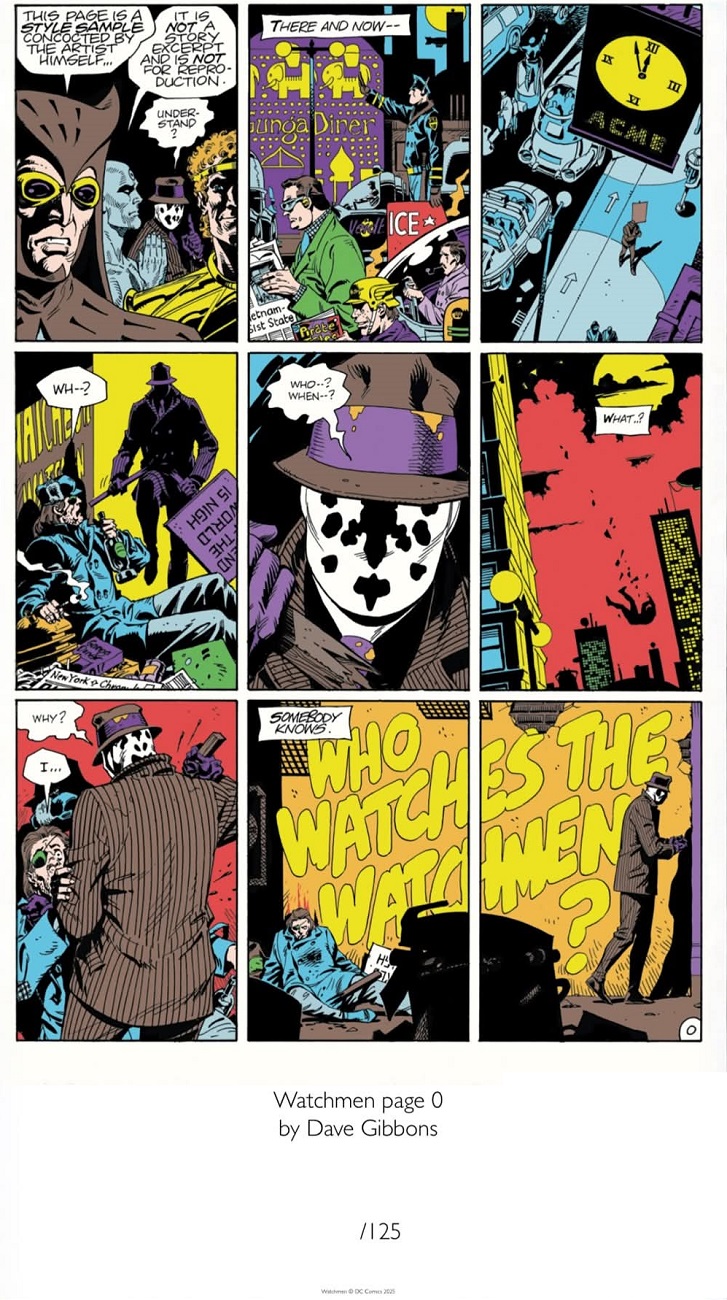
Watchmen page zero... in color


For that occasion, Gibbons drew a brand new Rorschach image (above) printed as special coaster and... colored, for the very first time, that famous Watchmen page zero, available as limited print at the show (see below)!
Wer überwacht die Überwacher?

Jun 22, 2025
Un-used Swamp Thing 21 cover
 |
| Art by Thomas Yeates |
Few days ago, collector Richard Donnelly posted the above image on his CAF gallery.
It's an un-used cover art by Tom Yeates for the seminal Swamp Thing The Anatomy Lesson issue, cover date February 1984.
Donnelly writes: "This un-inked pencil cover with two surgeons and a nurse about to vivisect Swamp Thing was likely rejected by Comic-Code or DC editorial. Signed with note and sketch by Thomas Yeates."
The official cover - now a classic! - was actually less direct and explicit.

Jun 14, 2025
Watchmen by John Amor


Jun 11, 2025
Das Grosse Wenn

I confess I find the image quite... mesmerizing. Gut gemacht!
Jun 8, 2025
Yuggoth: unpublished Lovecraftian tales
 |
| Art by Enrique Breccia. Not related. |
But let us take one thing at a time.
Moore had already said that, despite his retirement from the world of comics, there could still be some unpublished comics written by him out there.
Alan Moore, in 2024: [...] "There may also be other comic book work out there, as yet unpublished, but volume four of The League was my last comic strip work, and was also, I think, a fond and comprehensive farewell to the medium."
In particular, after the conclusion of Providence it was rumored that he had written a sort of epilogue or spin-of linked to the Lovecraft lore.
Well, as reported on Reddit, in 2024 Garth Ennis admitted that... it was all true. This happened in a video interview that the acclaimed Northern Irish writer did for Monsters, Madness and Magic channel, posted on Youtube the 14th of November 2024 (watch it around minute 50).
Monsters, Madness and Magic: [...] Have you and Alan had a chance to work together previously? I probably just slipped my mind if you guys had...
Garth Ennis: Well not not directly but Alan wrote a series of Crossed which was that horror story that I created some 10 or 15 years ago. Alan did a sort of a 100 years in the future version of that... and it was very gratifying that he would be interested enough to do that...Someday, you might see a series from Avatar, the publisher who sadly semi imploded and seem to have ceased publishing. But there's a series called Yuggoth, and it's based on the work that Alan did - Providence, Neonomicon, and some of the other Avatar books he did based on his love of H. P. Lovecraft.And Yuggoth was going to be an anthology series. I do hope people see it. Alan wrote the first storyline.Mine would have been the second. You also have Kieron Gillen in there and Si Spurrier. All this is written and drawn.I do hope Avatar will publish it one day because it's tremendous stuff. And it was lovely to be able to play in the extremely dark and unpleasant universe that Alan had been able to access through his interest in the lore of Cthulhu and H. P. Lovecraft and so on."
Later on, on Bluesky, Kieron Gillen confirmed the thing, sort of:
Kieron Gillen: "My stuff isn't complete, it should be stressed - it only exists in script. [...] I don’t want to reveal stuff that Garth hasn’t - but I believe all the other stuff is, and more."

Then I started thinking about the possibile artists involved in the project. And I remembered that years ago there were rumors about Gabriel Andrade, who worked with Moore on Crossed +100.
So I contacted him and...
Andrade replied: "Yeah! I was part of this work!The story is a prequel that reveals much of the lives of dark characters who appear in Neonomicon and Providence, showing their experiences with the occult and ancient magic. I did the art for two entire arcs of 6 issues both. The first, written by Alan Moore and the other by another author, who I can't reveal. They are incredible stories.Unfortunately I have no idea if this will ever be published."
What else to say... we need those stories published... the sooner the better!!!
Maybe we could put a dark spell on that! :D
May 31, 2025
A Big Numbers moment

So, this time I share a little gem posted by a certain Tallestpurpl on his X account the 18th of November 2023, date of Alan's 70th birthday. It's a funny memory, imho. Enjoy!
My favourite story: knowing nothing about comics but knowing Alan from the pub I worked in, I was told by my comic fanatic friend to ask what had happened to the rest of Big Numbers. I did over a pint one night; there was a moment of silence before Alan asked if I wanted a fight. - Tallestpurpl

May 27, 2025
The Soul, Tarot and an iridescent perspex box

It's a new chat with the great John Coulthart about The Soul, Tarot and special editions! Enjoy! And... Grazie mille, John, for your generosity!
The Soul chapter 3, the sexual ritual episode. Was it a difficult chapter to illustrate?
John Coulthart: No more so than any of the other chapters.
What's about your decision, apart for the opening illustration, to draw small, vaporous, sketchy illustrations inscribed into a circle? Was it a way to communicate a sense of intimacy to the reader? I am curious also about the crescent moon and triangles dynamic included on the upper part of the pages.
I wanted to vary the style and layout of each chapter a little in order to create variety and also parallel in a small way Adeline's magical progress. The setting of Alban's studio suggested a sketchier drawing style while also avoiding the illustrations being too explicit. I've no qualms about doing sexually explicit artwork but such a thing wouldn't have been right for this particular book.
None of the documents for the Soul story gave any indication as to how the chapters should be illustrated so the symbols at the tops of the pages are my own addition, something to once again indicate the magical dimension as well as the different characters. The intersection of the triangles of Water and Fire are referred to in the text so I developed this into iconic representations of Adeline and Alban's sexual encounter. Adeline's inner life is represented by the Moon; the Water triangle is her external life. At the end of the chapter the two haven been joined, something made possible after the earlier conjunction of inner elements (Sun and Moon) and outer elements (Water and Fire).

In chapter 4 you are back to a more classic illustration approach. I can also feel a bit of Finlay vibes in the full page Moon palace illustration, even if it's in colour. Can you talk a bit about this fourth section?
The most novel element in chapter 4 was the border which was adapted from a versatile Viennese artist and designer, Koloman Moser. The border is another element from the Art Nouveau period but it's an unusual design that's sufficiently abstract to lend itself to different interpretations. The elaborate border also compensates for there being fewer illustrations in this chapter. I didn't want to extend the page count needlessly but I did want to have that full-page picture of the Moon palace. I wasn't thinking of Virgil Finlay's style but the drawing is certainly the closest one in the book to typical fantasy illustration.What's about the simplified Tarot deck that you designed? Originally, if I remember right, there were plans for an actual brand new Tarot deck to be included in the book or as a separate item...
Yes, José Villarrubia was going to be doing a complete Tarot design for the book when it was first announced in 2007. I think one of the ideas was to have the cards printed in such a way that they could be detached from the book and used as an actual deck of cards. In addition to spoiling the book the production costs would have escalated if this was the plan since the cards would have to be printed on heavier stock then perforated around their edges. As it turns out, Alan and Steve subsequently decided that inventing an entire deck of cards with 78 unique pictorial designs is a major task in itself, especially if you want to try and add anything to the vast corpus of imagery that already exists in the history of the Tarot. Alan later said to me that he didn't really think the Crowley/Harris deck could be easily improved upon, not unless you spent years working on the new designs to the exclusion of everything else.All of this left me with a problem when I came to design the book. The removal of the cards cut down the page-count considerably yet we still had an essay about the Tarot which needed to illustrated. After considering a couple of options such as trying to licence cards whose designs are still in copyright I decided to use two decks simultaneously: one of them very old and the other--my own designs--very new. This had a number of advantages: in addition to showing how the Tarot iconography can work in different ways the designs show the two main arrangements of the Major Arcana, one with the older, Christian icons like The Last Judgment, the other with the Crowley arrangement which updates some of the cards. The Marseille cards, incidentally, were coloured by myself from an old set of black-and-white prints.

Expanding this idea of separate items... well, sure the book is fantastic.. it's a real, amazing, colourful grimoire with that British flavour of old children annuals... but I was daydreaming about a version of the Bumper Book as... a Magic Box full of books, printed objects of different format and design. Maybe the complete The Soul story as a single small hardcover book with a Victorian cover and all your illos... the Alexander comics as a comics newspaper... the enchanters as a single french format comic album... and so on... a bit like Ware's Building Stories... What do you think about it? Was there ever a time, a preliminary brainstorming moment, when you considered a different format/package for the Bumper Book?I did make a jokey comment to the publishers about a future special edition in an iridescent perspex box with ceremonial robes and so on. Even though I like special editions and unusual packages I think I prefer the book being the way it is, especially when it was designed to be read as a single work. Adeline's magical evolution takes place while you're reading about the evolution of magical practice through the ages, and also being offered tips to your own practice in the Rainy Day chapters. The book ends with a recapitulation and summary of the contents which then describes the magical evolution of the authors. To borrow a favourite reference point of Alan's, it's like the Beatles' Sgt. Pepper album: you can extract individual songs but the songs themselves work much better in an album format with a definite beginning, middle and end.
Subscribe to:
Posts (Atom)