
From Elric book published by Titan in 2021.
Thanks to Omar Martini for the discovery and pics.


 |
| Art by Mark Badger |
 |
| Art by Zu Dominiak. Story by Chris Murray. |
Dominiak wrote: "Wraparound and interior art, lettering, coloring, inking... of a comic written by Chris Murray. It was one of my favourite projects to work on, including references to many of Alan Moore's works!"
 |
| Art by Zu Dominiak. Story by Chris Murray. |
 |
| Art by Alpraz |
How do you want to be remembered?
Alan Moore: I don’t really much care, because I won’t be around to glory in it. I don’t know, as somebody who was a good writer, a decent magician and who tried to follow his path with integrity to the best of his ability. And also that I was really sexy. That would do. Put that on the tombstone.
[...]
DAVID ERDOS: [...] While there are many artists whose Work embodies a visionary status, very makers are as equal or as mythic as the work itself, at least in the minds of others. There’s you, Ballard, Heathcote Williams… How do you define a visionary in the full cultural meaning of that word?
ALAN MOORE: Well, I’d say that with a visionary it’s always got to be personal. It’s got to be a personal vision. I think if you look under visionary in the dictionary you’ll see a picture of William Blake. He’s pretty much the archetypal visionary. As I’ve said elsewhere, human beings don’t come a lot better than Billy Blake. I suppose what this is connected to is finding a way of seeing. There was a performer called Nicholas Curry who worked under the name of Momus. Well, I remember one of his songs; there was a snatch of lyric that stayed with me: ‘I’m in love with everyone who knows its hard to find a way of seeing. Who knows that nevertheless that is the only way to flame into being.’ And I think that this is the important thing: to identify the way in which we see the world. And to then communicate that; to develop the skills that we will need to communicate that: Sing your particular song. Give your particular view of the world. And as far as I can see it, one subjective view of the world is not privileged over another. Everyone’s subjective reality is the entire universe. And they are constructing it entirely within the confines of their mind.
[...]
DAVID ERDOS: [...] Its a common argument in theatre for instance that all you have to do is entertain. I’ve never believed that. I think the theatre has to include that of course but is actually about something else: ideas, exploration, challenge, transformation. And that a play is a list of ever changing or uncharted decisions. It’s why I’m a great Pinterist. In his plays everything is both true and untrue at any given moment and you have to navigate each silence, and each mystification.
ALAN MOORE: Of course I have great respect for Pinter as a dramatist. I am more of a Bertolt Brecht geezer. In that I – I mean, I’ve always liked Brecht, but I’ve only recently realised in fact, how much my own methods were an unconscious approximation. I’d never heard about Brechtian alienation, until I realised it’s what I’ve been doing all my life. The thing about Brecht is that he took hugely difficult moral and political concerns, and he mashed them up with the most appalling and vulgar popular media; sing songs and cabaret..
DAVID ERDOS: Shows about murderers, reprobates, prostitutes, tyrants, capitalists!
ALAN MOORE: There are ways in which almost anything can be communicated, and I think the onus on us is that we can’t continually complain about the public, because they’re only responding to what they’ve been fed, and what they’ve been conditioned to like. We should be able to offer more tempting dishes with our culinary skills, and if we can’t make them irresistible enough, then that really is on us. Certainly, it would help and be encouraging to get more response from the audience out there, but I think its our fault, rather than theirs. Or, rather, that is the best way for us to regard it. That we should buck our ideas up and try a bit harder to captivate people.
[...]
DAVID ERDOS: [...] Do you think then, that it’s about reaching large groups of people anymore, or is that future more about finding widespread and more selective groups? As a way of starting that culture again. Do you think that we need to start that culture again?
ALAN MOORE: Hmmn. Well, I myself would like to see a material culture. This might be because of my own prejudices. But I think you’ve got to have material culture before you can have material counter-culture. I think the idea of magazines is a great one. Maybe this is never coming back, but it struck me recently that the way that I and many of the people I knew managed to find ourselves in our current positions, or got to the point that we wanted to get to in life; a lot of the ways we used, are simply not there anymore. I was asked to do an intro for a very very good biography of Malcolm Mclaren that came out recently, and it occurred to me while I was reading it, that there was a particular scaffolding that enabled us to climb into those positions. It was Art Schools, Arts Labs, in my own case, to start with; the underground press, which then vanished, or at least the national underground press did. By which time there were poetry magazines, and they endured while there was the brilliant poetry boom of the sixties and seventies. Then there were regional alternative papers… then there were regional newspapers, whether they were alternative or not..there was the music press, which was one the ways I got into being an artist and writer. But all of the ways, all of the steps, all of the handholds that got me to where I am don’t exist anymore. And I am suspicious of the fact that the modern handhold are all owned by some tech company or other. I mean, I was talking to my grandson, one of my grandchildren, and he was talking about how at the moment he’s looking forward to becoming a Youtuber! I mean, he’s ten, you know..but then my daughter Amber who was in the background chipped in and said that maybe having your own Youtube channel was like having your own fanzine! And when I was talking to Jarett Kobek the other night he was talking about how he had started a book about Youtubers, and the tragic stories of a number of them, as he was saying that for a lot of these kids, unless they become one of the successful Youtubers, all they’re going to be or have are all of the disadvantages of being well known and none of the advantages. I mean, a lot of them – and I wasn’t talking about this to my grandson – but a lot of them have suicided. And Jared said, and this is very unlike him, that he gave up writing the book because it was just too depressing. He couldn’t actually face doing it anymore as it was making him feel terrible about humanity. So, yes, I’ve got my reservations about all the modern media. I would probably greatly prefer a return to material media, because I think when you’ve not got that physical artefact the atmosphere behind a counter-culture suffers. It’s an intangible and ephemeral feeling that needs something physical to actually coalesce around. There’s a number of problems that I have with virtual online culture. I can’t really comment on it much because I’m not part of it. But I’m not part of it for a reason. So, I really applaud any attempt to do print media, because I think people want them. It’s like vinyl albums…
DAVID ERDOS: The future is still in the past!
ALAN MOORE: Yes, I think it is. And we should also not assume that every new thing is progress. It might just be a new thing! It doesn’t mean that it’s better than what came before.
[...]
The main thing that I learned about conspiracy theory, is that conspiracy theorists actually believe in a conspiracy because that is more comforting.
The truth of the world is that it is chaotic.
The truth is that it is not The Jewish Banking Conspiracy, or the Gray Aliens or the twelve-foot reptiloids from another dimension that are in control.The truth is far more frightening - Nobody is in control.The world is rudderless.
 |
| Art by Claudia Corso Marcucci |
 |
| Art by Carlos Amadeu |
 |
| Art by Hannah Hildebrand |
 |
| Alan Moore Telegram Sticker pack by Nightgrowler |
 |
| Art by Nightgrowler |
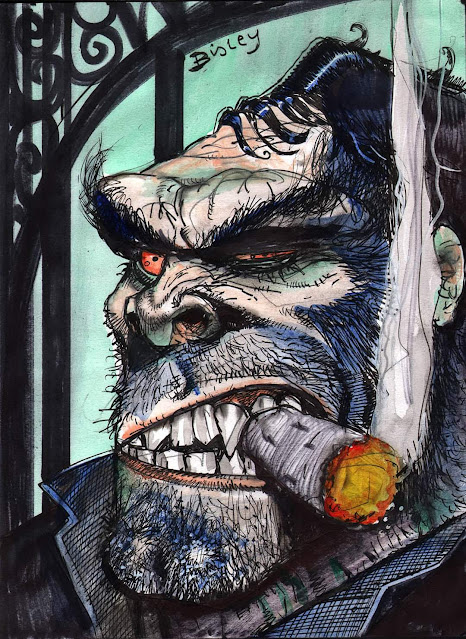 |
| Art by Simon Bisley |
 |
| Art by Simon Bisley |
 |
| Art by Simon Bisley |
George Khoury: [...] you were going to do this book originally with Simon Bisley?
Alan Moore: Originally, I’d put the idea forward without an artist attached to it, to Kevin Eastman, I think. And at that point, I think Kevin Eastman had advanced me some money on the understanding that I would do a 64-page graphic novel for him at some point. And he wanted me to work with Simon Bisley. So that was the original idea, that we’d perhaps put together this League of Extraordinary Gentlemen thing.
But then I think I got a phone call from Kevin saying that he didn’t want me to do the graphic novel with Simon Bisley, he’d rather that I’d work off his advance by doing the Spirit stories for the Spirit comic that he was going to be bringing out. So I did those for that first issue of The Spirit with Dave Gibbons, which was great fun. So the other stuff never happened with Simon Bisley, and the idea was still around.
Then when I started thinking about it seriously, Kevin O’Neill was the artist that was right at the forefront of my mind. It just seemed, once I thought of Kevin, he seemed to be the perfect artist. He would allow the strip to evolve in a completely different way. Kevin’s work is meticulous, but there is an exaggerated and cartoony quality, which is part of its genius. And that kind of almost cartoony flexibility allows you a much greater emotional range in the strip. With The League of Extraordinary Gentlemen, partly because of Kevin’s art, we can span comedy, horror, and pathos in a couple of pages. Often in one page, sometimes in one panel. The emotional range that Kevin’s artwork lends to the story is fantastic. It’s one of the main assets of The League. There’s some scenes in there which are going to be horrible, silly, and all sorts of other things. Quite erudite, intelligent. It’s an interesting mix that we can get away with, regarding The League.
Eddie Campbell: Were you a fan of From Hell?
Maveal: I was! I think it’s one of Moore’s best works and I, of course, am always blown away by your artwork. It was very cool seeing it in color for the first time though. I — and I think a lot of other readers — have become so accustomed to seeing it in black and white and grey that seeing the addition of color is pretty wild.
Campbell: When I did the issues — the ten volumes — in the scene of Mary Kelly’s death, I had gone very light on the blood. When it printed in color, all the reds just disappeared! I looked at it and thought “I’ve had nosebleeds worse than this!” So I went in a added a lot more blood and red. I think it looks terrifying now.
Maveal: Hat’s off to you, seriously. The color of the blood alone is pretty harrowing. You got it to a nice, rich blue-red.
Campbell: Yeah, it was really nice. And I wanted to mention —and I had to fight for this really hard — that I had to argue to get the women put on the cover. I really had to fight for that. And they said “Nah, it’s too dark”, but I got my way in the end. I just wanted them walking in the street with the street-lamps and they said “Well can’t we have Jack the Ripper at the end of the street or something?” And I said no, just walking in the London street when they were happy and healthy and before it all went wrong.
Maveal: That’s a pretty hefty thing to fight for. That’s considerably darker than the original.
Campbell: Well when Alan [Moore] and I originally released it, we didn’t want people to know it was about Jack the Ripper. I put still life sketches on the cover back in the 1990s. Things like grapes or a melting candle and a cell phone [laughs]. The number on the dialed cell phone was the number for the publisher. It was Kitchen Sink Press and they noticed it right away. [laughs] But we wanted people to buy it thinking that it was a story about real life and the real world every. So often thing about jack the Ripper are horror stories in general. They take place in an environment that is designed to receive and produce horror. Horror…it just works at its best when it comes out of nowhere and you’re not prepared for it…
 |
| Art by Jeaux Janovsky |
"It's based off of Quentin Tarantino's Reservoir Dogs, in particular the Michael Madsen cop torture ear scene. But mixed with Disney's Goofy and Beavis of Beavis and Butt-Head fame.Quite a mash-up."
 |
| Art by Cristian Canfailla |


