Showing posts with label Dave Gibbons. Show all posts

Oct 12, 2026

Lo Spazio Bianco interviews DAVE GIBBONS!

Thanks to our friends at Lo Spazio Bianco, we are proud to present this exclusive interview with the legendary DAVE GIBBONS. 
Interview and photos by Emilio Cirri – Lo Spazio Bianco.
 
“If superheroes really existed, what would they be like?”
40 years of Watchmen with Dave Gibbons 
At the Munich Comics Festival we sat down with the artist of Watchmen to talk about the influences and legacy of one of the most important works in the history of comics.

Dave Gibbons is a veteran of British and international comics, and his fifty-year career speaks for itself, as do the countless anecdotes collected in Confabulation: An Anecdotal Autobiography, published by Dark Horse in 2023 and a true treasure trove of stories big and small. Over the decades he has left his mark on a vast range of comics, famous and less so, from Green Lantern to Superman, from Judge Dredd to Rogue Trooper and Dan Dare, to the Martha Washington saga with Frank Miller and his Vertigo graphic novel The Originals.
But without a doubt, the work that has carved his name in capital letters into comics history is Watchmen, which turns forty in 2026. Alan Moore’s realistic, deconstructionist approach might never have hit the superhero genre with such explosive force without Gibbons’s pages, where the rhythm of the now-iconic nine-panel grid tells the stories of cynical, disillusioned, violent heroes against the backdrop of a Cold War sliding towards apocalypse. His clean, realistic line, with its attention to detail and to the characters’ acting, set the standard for a generation and changed the way we picture superheroes forever.
 
There was no better way to open our short special on forty years of Watchmen — and, more broadly, on the anniversary of one very specific year, 1986, which turned the international comics scene upside down — than with an interview with Dave Gibbons.
Lo Spazio Bianco: Hi Dave, thank you for your time. I’d like to start at the beginning, before we get to Watchmen and everything else, with your relationship with science fiction. Early in your career you worked a lot on science fiction comics such as Dan Dare and 2000 AD, and over the years you’ve also produced a great deal of material for Doctor Who. Was your passion for the genre already there before you started working on these projects?

Dave Gibbons: I’ve loved science fiction for as long as I can remember. I have drawings I did when I was maybe six, seven, eight years old, full of spacemen and rocket ships. There was one in particular: a Jack Kirby image from a comic called Race for the Moon, showing a man chained to an asteroid floating in space. I remember copying it in art class at school, because it had made such a deep impression on me. The British weekly The Eagle, which starred Dan Dare — another space hero — was also a huge influence. My dad used to buy those comics for me. Later I found out that he’d loved science fiction too, before the war: he’d had some pulp and science fiction magazines that all got thrown out when he went off to fight in the Second World War. I grew up in a little village in the middle of nowhere, but we had a mobile library that came round once a week, and you could borrow books from it. That was another place where I discovered science fiction: whenever I saw a book with a spaceship on the cover, I’d pounce on it. I was reading two or three books a week, and when I found out I could actually order them, I dived right in: I read everything by Heinlein, Isaac Asimov, Arthur C. Clarke and all those great classic mid-twentieth-century science fiction writers.
I loved the escapism, and that “what if?” quality science fiction has. When I was working on Watchmen, one of the real breakthroughs came when I started thinking of it not as a superhero comic, but as a science fiction comic set in an alternate world.
 
Exactly. Watchmen is set in an alternate version of our world and asks what would happen if superheroes really existed. At the same time, the story is permeated by a constant sense of impending apocalypse.
The story also asks: if superheroes really existed, what would they be like? They certainly wouldn’t be like Superman or Batman — they’d be something very different. The world would welcome them, but at the same time it would be afraid of them and wouldn’t trust them. So in the end, Watchmen really explores science fiction ideas through the lens of superheroes.
Speaking of superheroes and science fiction, when you broke into the American market you started working on characters like Green Lantern and, over the years, on many of DC’s more cosmic heroes. Was that science fiction connection one of the things that drew you to DC Comics? In your autobiography you also mention that DC was your favourite publisher.

Yes, I loved DC Comics because it felt very clean, very precise and incredibly well crafted. A lot of my favourite American comics were edited by Julius Schwartz, one of DC’s editors, who had previously worked on science fiction pulps. He’d also been the literary agent for well-known science fiction writers like Ray Bradbury and Edmond Hamilton, so there was a strong science fiction sensibility behind a lot of those comics. I was particularly drawn to Green Lantern because, once again, it opened the story up to the whole cosmos. I was fascinated by the idea of an intergalactic police force in which Green Lantern was just one member. There were all these alien beings wearing the same uniform, and I loved the idea that there was this vast civilisation out there, with Earth sitting right on its fringes.
Another big influence on me was a British newspaper strip called Jeff Hawke which, as I understand it, was also very popular in Italy and other European countries. It approached science fiction in a slightly quirky way, with a sense of humour and a touch of the absurd. I found that combination fascinating, and it was certainly one of the things that drew me to the genre.
 
Earlier you mentioned the many influences that helped shape your work. One of the most striking things about your autobiography is the sheer number of names you cite — some very famous, others much less so. I know it’s a tough question, but if you had to pick one major influence from your early years, who or what would it be?
I think there are simply too many influences to single out just one. There’s the DC Comics science fiction tradition, but there’s also what Jack Kirby and Stan Lee were doing at Marvel. Ideas like Galactus, Ego the Living Planet, and the feeling that beyond Earth there was a whole universe of civilisations — those fascinated me. So I really couldn’t point to a single influence: it was a combination of all those things.

Turning to Watchmen, this year marks its fortieth anniversary. Looking at the book today, how has your relationship with it changed? It started out as a self-contained project, but over the years it has taken on a life of its own — not just commercially, but through adaptations, spin-offs, prequels and sequels. What does Watchmen mean to you now, four decades on?
I have to say I’m amazed that, forty years later, it still has the influence and popularity it does. When Alan and I created it, we never imagined it would last this long. We honestly thought we’d do our twelve-issue series, it would come and go, and eventually it would end up in the back-issue bins of comic shops. We had no idea it would have the longevity or the impact it has had. As a creator, it’s incredibly rewarding to see more and more people discovering your work. It’s deeply moving to think that something we made so long ago still matters to so many readers. In fact, it’s been so long that I can almost look at Watchmen as if somebody else had made it, because forty years ago I was a very different person. And that in itself is a mind-boggling thought.
I’m also very glad that a film adaptation eventually came along that was, in my view, a very good film. It wasn’t perfect, but everyone involved gave it their all. The same goes for the animated adaptation: I had a few reservations at first, but I think in the end they did a superb job. Right from the start, Alan and I had always thought an adaptation was possible — we thought that one day there might be films or animated versions of the story.
I’m less keen on the prequels and sequels, because I think Watchmen stands on its own. That’s the story we wanted to tell. If you start filling in too many gaps about what happened before or after, you risk weakening the very thing that made the original work. It’s like explaining a joke: once you’ve explained it, it often loses its punch. That said, I’m not angry or upset about any of it. On the whole, the book has been treated very well. It’s been an extraordinary success, both artistically and commercially. It’s obviously the defining work of my career. I’m sure that when my obituary is written, the word Watchmen will be in the very first paragraph — and honestly, there are far worse things to be remembered for. It has exceeded any expectation I could have had, and I’m simply grateful that, after all these years, people still care.
Watchmen
changed the way superhero stories are told in many ways, but I’d like to highlight two. The first is psychological — the depth of the characters. But there’s also a visual side: the aesthetics, the realism of the bodies, the gestures, the expressions and so on. There’s a deep sense of humanity that somehow harks back to what some superheroes were in the beginning — more human than superhuman. How did you approach that side of the work? What was your approach to these characters, and was there one in particular that really stayed with you, one you found yourself empathising with most while you were working on the story?

I think, once again, the question to ask is: if superheroes existed, what would they really be like? And then you can ask: why would anybody want to be a superhero? They might be people like Nite Owl, a rich kid looking for his adrenaline fix, so he spends his money on an owl-shaped ship, a costume, gadgets and all the rest of it, like Batman. Or they might be people like Silk Spectre. It’s a family tradition: her mother was a masked heroine, so she’s supposed to be one too. Or, in the case of Dr. Manhattan, somebody who has the powers of a god but never wanted them in the first place. He isn’t interested in helping humanity or fighting crime; he gets lost in his own thought processes and in his ability to make things manifest. So he’s rather self-absorbed and completely detached from whatever happens to humanity.
When you start exploring characters like that, you give them body and depth, instead of just having them say, “I’m one of the good guys, I’m going to fight crime.” That’s too simplistic. We were after complexity; we wanted to explain the reasons behind what they did. And that also means — going back to what I said about it being a science fiction novel — that you don’t approach it like a regular superhero comic, all big splash pages of musclebound figures leaping over the skyline, but on a much more human level: people in human spaces, interacting in human ways.
And inevitably, when you create characters, you get to know them. The one closest to me is Nite Owl, because as a kid I used to make up my own stories and amateur characters. I had a character called Nite Owl, and I suggested to Alan that a character with that name, with the whole owl theme, could be our Batman stand-in. And he said, “Yes, great. We’ll spell it N-I-T-E O-W-L, the American way.” So he’s a character who’s very close to my heart. I own one of the props from the film, the statue of the original Nite Owl, and I look at it every day and think: isn’t it incredible that this thing I drew when I was fourteen ended up in a movie and was seen by millions of people all over the world? So yes, I can understand why people like Rorschach — even though he’s a terrible person, he knows what he believes in and has an enormous amount of certainty. But for me, it’s still Nite Owl.

I think, looking back, he’s probably someone a lot of people can relate to. He’s more of an everyman who becomes a superhero, but then he gets older and, once his career is over, he puts on a bit of weight, gets a bit of a paunch. I don’t know, maybe it’s also something we can relate to as we grow up: when you’re young you do all sorts of things, and then, as time goes by, you gradually slow down and get older.
Exactly — you stop working out, and obviously you stop fighting crime as well, so he just sits in his basement thinking about the good old days. So there’s that element of nostalgia too.

Another aspect I’d like to talk about, in terms of style and storytelling, is the nine-panel grid. Obviously you didn’t invent it, but since Watchmen it has become more and more common in comics, and for many creators it’s become a homage or a stylistic choice. How did this particular storytelling approach come about? And as far as your style and this structure are concerned, what were its advantages, but also its limitations and challenges for you as an artist?
I wanted Watchmen to look completely different from any other American comic, so that you’d only need to glance at a page to know it was Watchmen. At the time, back in the eighties, there was a lot of what I’d call the movie-poster approach to comic art: a big image of the hero flying across the sky, and then the story told through smaller images, with the aim of making the whole thing work as a poster rather than as part of a story. Since we were going to tell a very complex story, I thought using a nine-panel grid would give it a unique look, unlike anything else on the stands. Alan also realised it would give him a lot of control over the pacing and would draw the reader into the story. The trouble with posters is that you look at them as a picture and then read the story almost as if it were an article. We wanted the story to be the main thing, and the pictures to be almost invisible. You weren’t supposed to think, “Oh, this is a work of art” — you were just supposed to lose yourself in the story. It was also a very common way of making comics, especially in European and British comics.
I think that, together with the colouring, helped give Watchmen its distinctive look. I had very specific ideas about the colour palette I wanted, which was different from the usual American comic book palette. So I spent a lot of time talking with John Higgins, my friend who was the colourist, to get that kind of European comics look and give the book a different flavour.
Exactly. Because your style in general, and Watchmen’s in particular, seems to look more towards the European tradition, including the ligne claire.

I’ve always tried to adapt my drawing style to the comic I’m working on. Watchmen is drawn in a style very close to the clear line, but I’ve done other things, like Martha Washington or Doctor Who, where the compositions are much more explosive. So it’s not that this is my one fixed, unchanging style — it’s just the style I chose for Watchmen.
 
Having read and reread Watchmen, I’ve found myself increasingly drawn to the secondary story, the story within the story: Tales of the Black Freighter. It strikes me more and more because it acts as a counterpoint to the main plot. In a way it explains what’s going on, but through a completely different story and perspective. And the style is closer to the EC comics. How did you work on this part of the book? Was it developed alongside the main story or separately? And how did the idea come about?
When Alan and I were first building the world of Watchmen, I drew up a long list of things I thought could be interesting elements. There were things like, for example, the fact that, since it was an alternate world, there would be different fast-food chains and different fashions. And it also occurred to me that, in a world where costumed heroes really existed, there probably wouldn’t be a market for superhero comics, because they’d seem redundant. But what could have the same kind of appeal, glamour and violence as superhero comics? I thought: maybe pirate comics. They could fill that space. I suggested the idea to Alan, and in the very first issue there’s a street scene with a kid reading a pirate comic. We could have stopped there, but when we talked it over further, Alan said, “You know, we could actually tell that pirate story, reproducing it from the comic.”
At first I wasn’t sure it would work, but he wrote it and it did: as you say, it became an allegory for what was going on, with Ozymandias, of course, clambering over other people’s corpses. And, you know, we could give it a bit of colour, and since the main story had some fairly cerebral elements, it would add that sense of swashbuckling adventure. That’s an example of how collaboration works. I’d had the idea of the pirate comic, but what Alan did with it went far beyond anything I could ever have imagined.
 
If we look at the world around us today, and especially at this particular moment in which we’re having this conversation, there’s once again a feeling of living in the shadow of an apocalypse. What would Watchmen be today? If you thought about creating something similar now, would it still be possible? Could it still be told in the same way?
I think the world has become much more complex, and the stories happening in the real world are more complex too. Back then it was more a case of, “I’ve got a nuclear bomb, you’ve got a nuclear bomb — do you want to fight?” You know, in the end it boiled down to that. I think it would be very hard today to explore a lot of what’s going on in the real world. I think there’s something elemental about what happens in Watchmen, if that’s the right way to put it. We’re on the brink of apocalypse because of the hostility between two superpowers, the United States and Russia — and when we made the book, that was very real. In England there was a television drama called Threads, which showed how fragile society was, and back then we really believed it, emotionally as well. When it comes to society’s modern problems, to do with terrorism and economic conditions, it’s much harder to make them archetypal. So I don’t think Watchmen would work in exactly the same way today, but I’m sure you could tell a story that would have a similar impact. I just don’t know what it would be. Perhaps that’s not a very satisfying answer.

I think Watchmen is still interesting from a historical perspective, too.
Yes, what I’m trying to say is that Watchmen very much belongs to its time. It sat at a very specific point in history, and we captured a lot of what was going on at that moment. When Gorbachev was the leader of Russia, he had a meeting with Ronald Reagan in Reykjavík, Iceland, to talk about weapons and what would happen in the future. And the first thing Ronald Reagan said to Gorbachev was, “Hey, Mikhail, you know what we really need? An invasion from Mars. That would get us working together.” Which is basically what Watchmen is about. I think you can still explore that theme, even though the world has become much more complex than it was in the eighties. Yes — does that make sense?

It’s interesting to take that idea further: how would the creators of Watchmen imagine humanity’s reaction to something like that today? Would it really bring humanity together, or would the reaction be completely different?
One important point is that technology is also very different today. You know, with computing power, artificial intelligence and all these things, there are many ways society could be thrown into chaos, and they’re not limited to nuclear war. And we see it every single day in the news.

Thank you so much for your time, Dave.
 
Interview conducted at the Munich Comics Festival in June 2025.
Many thanks to the organisers for their support.

Jun 19, 2026

Rorschach is watching you!

 
Above, a fantastic Rorschach portrait (pencils) drawn by DAVE GIBBONS for an Australian collector in 2009. Sure, I am jealous! 
Below,  the inked version realised by Gibbons on a blueline copy in 2013.

Jun 23, 2025

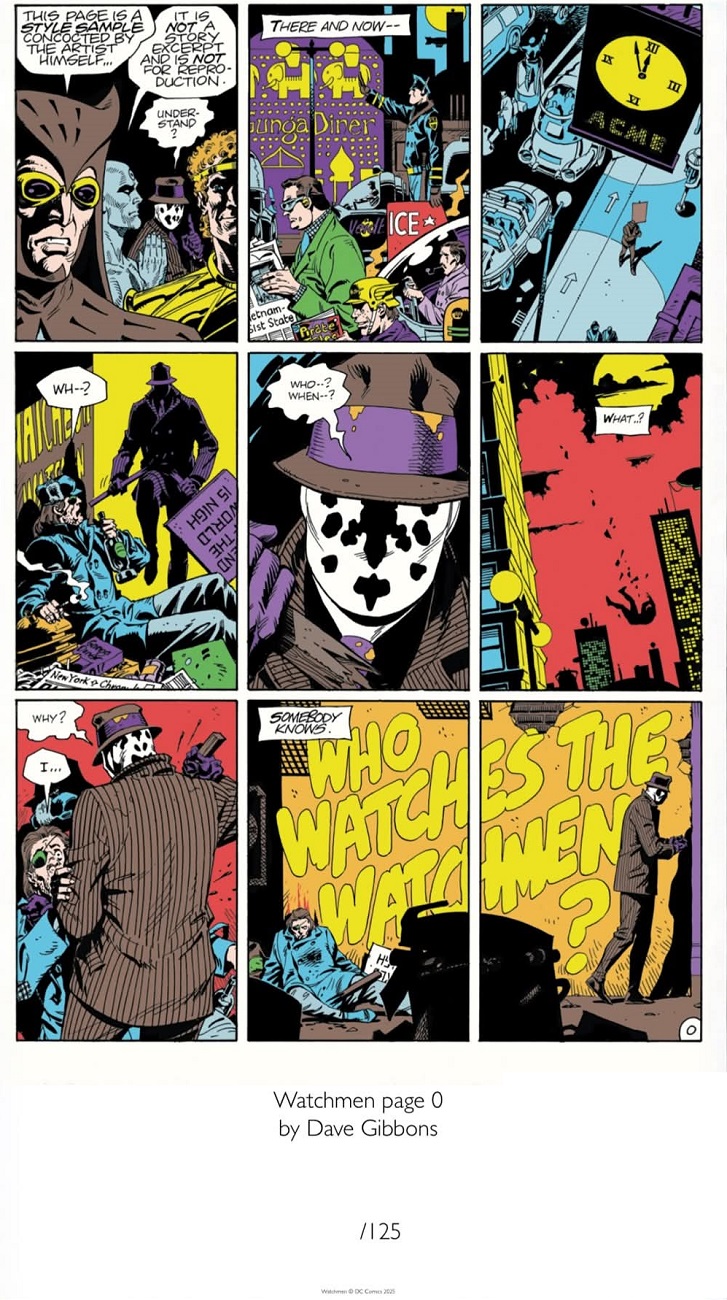
Watchmen page zero... in color

In the past days, Dave Gibbons was in Munich as special guest at the local Comic Festival. (19-22 June)
For that occasion, Gibbons drew a brand new Rorschach image (above) printed as special coaster and... colored, for the very first time, that famous Watchmen page zero, available as limited print at the show (see below)!
Wer überwacht die Überwacher?

Mar 19, 2025

Brian K. Vaughan's Watchmen birthday card

On the last installment of his excellent Substack newsletter Exploding Giraffe (you can subscribe HERE), dated Monday 17th of March, extraordinary writer Brian K. Vaughan talked about some difficult moments and... an happy ending (sort of). Of interest to Moore's fans.
Brian K. Vaughan: [...] Well, how’s your dystopian 2025 been so far?

Los Angeles obviously endured some horrific wildfires, and though my family and I are completely fine, we’re devastated for our friends who lost everything. [...]

We voluntarily evacuated not long after the ash started raining down, and I left behind just about all of my worldly possessions, so when the flames started approaching our neighborhood, my dear friend/collaborator Jeff Yorkes (and his wife and kids!) raced over to our abandoned place to rescue as much of my obnoxious original comic art collection as they could pry off the walls, including this eerily appropriate recent acquisition: a hand-drawn birthday card by Watchmen co-creator Dave Gibbons [...]

Aug 25, 2024

Watchmen Page Zero

Art by Dave Gibbons
The page was included in Watchmen Artifact Edition, published by IDW in 2014. Art by Dave Gibbons. 
 
Project mastermind Scott Dunbier explained that it “was done for DC as a sample of the style the book would be. Note the page number in the bottom right corner.”
 
Amazing artifact! More info HERE.
 
The page appeared for the first time in the extras section of Watchmen limited edition published by Graphitti Designs in 1988. The same extras were included in the Absolute Edition published by DC Comics in 2005. The page was presented with a yellow flat color on each panel. The IDW edition showed the b/w, original art page.

Jun 5, 2024

Moore Great Comics

From The Men's Health Comic Book Omnibus article published this June:
Finding a great comic can be tough. So we asked 45 of the most legendary, visionary, and unique creators in the business to make it easier. 
I selected the Moore's entries: we have 3 votes for Watchmen, 2 votes for both From Hell and V for Vendetta. You can read the complete article HERE.
 
Gail Simone
Writer of DC's Birds of Prey, Wonder Woman, and Marvel's Deadpool:
From Hell
by Alan Moore and Eddie Campbell
"To say this is a book about Jack The Ripper is like saying Moby Dick is about a guy who goes fishing. It’s comics wizard Alan Moore’s best, most compelling work, told from multiple points of view and containing worlds in its story of murder, corruption and class. Stunning visuals by Eddie Campbell carry it beyond."
 
Bruno Redondo
Artist of DC's Injustice and Nightwing:
V for Vendetta
by Alan Moore and David Lloyd
"This comic was the first that made me break into tears. It showed me how comics can be powerful, filled with emotions and ideas. Comics can change your mind, and V was this for me. Masterful and brave storytelling."
 
Nicola Scott
Artist of DC's Wonder Woman, Birds of Prey, and Image Comics' Black Magik:
Watchmen
by Alan Moore and Dave Gibbons
"Because DUH. Infinitely re-readable."

Sina Grace
Writer of DC's Superman: The Harvest of Youth, Self-Obsessed and Not My Bag:
V for Vendetta
by Alan Moore and David Lloyd
"Look, someone else is gonna say Watchmen, but I find myself revisiting V for Vendetta a lot in my life, and every time the graphic novel slaps harder than ever. It’s so much fun to read Alan Moore buildma political and ever-poignant dystopian narrative from the ground up, and the Guy Fawkes design for V makes for one of the most elegant and startling characters in comics history."

Joe Hill
Co-creator of Locke & Key and author of NOS4A2 and The Black Phone:
From Hell
by Alan Moore and Eddie Campbell
"If the graphic novel form has a Ulysses, this is it. Watchmen made Moore a legend, but From Hell is better, a knotty, salty, grand Guignol that paints the late 19th century so vividly, reading it is practically the same as time-travel."

Axel Alonso
Former editor-in-chief of Marvel Comics and founder and CCO of AWA Studios:
Watchmen
by Alan Moore and Dave Gibbons
"Easily the most pivotal, influential graphic novel of all time, you see two Maestros of the craft deconstructing the superhero paradigms of the past with an eye fixed firmly on the future."

Mike Deodato, Jr.
Artist of AWA Studios's Bad Mother, The Resistance, Not All Robots, and more:
Watchmen
by Alan Moore and Dave Gibbons
"My first pick goes to Watchmen by Alan Moore and Dave Gibbons, for defining and changing the medium and what comics can achieve. One of the greatest comic books ever made."

The complete article is available HERE.

Apr 3, 2024

Comics Are Dying: The Comic

Alan Moore is IN! Check the homage to a classic Watchmen page above!
 

Comics Are Dying: The Comic
by Louis Southard and Over 100 Artists

A satirical journey through the history of the comic book industry recounted by 100 one-page comics by 1 writer and 100 artists.

A Comic Book About the Comics Industry, By the Comics Industry, For the Comics Industry

Foreword by Mark Waid

Jan 28, 2024

TCJ Dave Gibbons

DAVE GIBBONS: [...] For instance, my classic collaboration with Alan Moore doing Watchmen and the other things we did - I felt a great connection in that he was an artist. He was a writer who could draw quite good comics. And I was an artist who could write quite good comics. So we were close together in the middle. [...]

Talking about Watchmen's contract: [...] So there was no question of anybody putting pressure on us. It's not even me putting pressure on Alan to sign anything he didn't want. We've all signed bits of paper that we really wish afterwards we hadn't signed. It doesn't necessarily mean that there's any evil intent in it. But what I would say with Alan-- and I think these things go hand in hand. I've become reasonably well-known and famous because of Watchmen. But Alan's talents, and I think Frank Miller's talents, are on a different level than so many of us. What comes along with that degree of talent is a degree of difficulty as well, that people want things from you. That people are continually trying to get you to do things for them. And I think that that can quite often taint things. [...]

[...] Well, clearly Watchmen was the Everest of my experience, really. And I'm perfectly at ease with that. It's been good for me in all kinds of ways, not only in whatever money we've made from it, or whatever fame we've had, but it's opened doors to other things. And I've had adventures that I otherwise wouldn't have had. So I'm long since resigned to the obituary reading “Dave 'Watchmen' Gibbons, dead at the age of 105,” you know, blah, blah, blah. I just feel happy that I've had the life that I wanted when I was 10 years old. There's so many people [who] aspire to do things. Perhaps [that’s] because I had a relatively easy thing to aspire to. I mean, I didn't want to get a Nobel Prize or a Pulitzer or anything like that. I just wanted to sit and draw comics. And that was literally what I wanted to do, just to find enjoyment sitting, drawing, coming up with ideas for comics. So I don't care what they call me or-- you know, “Dave Gibbons: the comic fan who never grew up,” or something like that, I guess would be a fairly accurate thing. But I think I'm going to have to settle for Watchmen.
The complete interview is available HERE.

Mar 24, 2022

Jeffrey Lewis and Alan Moore (again)

Art by Jeffrey Lewis
In the past days, I was lucky to exchange some emails with the great NYC comic book artist and musician Jeffrey Lewis. He suggested that it would be better off including all his various Moore-related stuff "in one post, because it's more valuable for people to see it all in one place for discussion, rather than parcelling it out to various posts where people won't see it all at once (which is, essentially, the situation all this material currently exists in, some on my FB, some on my website, etc)." 
So, here I am with this second post that integrates the first one I did (here). I am not sure it is the complete thing but... I tried my best, Jeffrey. ;)
Before starting, I highly recommend Lewis' The Complete FUFF Comix Collection: you can order a copy HERE!

Above, a Watchmen-inspired illustration posted on the 15th of March. Of course it's referred to the terrible, terrible war in Ukraine.

On a lighter note, in 2013 Lewis created the lo-budget biopic The story of Alan Moore (listen and watch here) and that same year, during his UK tour, he met... The Man Himself! Below, some pictures that Lewis sent me to share. Photographs by Heather Wagner.
Alan Moore and Jeffrey Lewis, 2013.
In 2015, Jeffrey Lewis listed his favourite comics for The Quietus: "bizarre autobiographies, superheroes and (SPOILER) a whole lot of Alan Moore". Lewis talked about:
  • Watchmen, of course - "[...] it's a work of literature in a way that no other comic has even attempted. It's not even the best of what it does, it's the only thing that has ever tried to combine that kind of narrative richness in the comic book form. [...] I like the fact that it really can't be assimilated into literary culture because it is so lowbrow, and yet it's undeniably of a level of richness to which no other comic has ever come close. [...]" Read the complete piece here.
  • V for Vendetta - "[...] nobody could make a list of the ten greatest comics of all time and not include V For Vendetta. Probably half the greatest comics of all time are Alan Moore comics [...]" Read the complete piece here.  
  • A small killing - "[...] This is probably the best Alan Moore book, in terms of sheer consistency, because it was written as a piece. [...] It's a paranoid fantasy that keeps revealing different layers of this ad executive's life. It's very sharp, page for page, the way that the story unfolds. There is a sense of revelation and unfolding mystery as you read it. [...]" Read the complete piece here.
  • Swamp Thing - "[...] Probably the best artwork in any mainstream comic of all time. Steve Bissette, John Totleben and Rick Veitch did really incredible artwork. And probably the best writing in any mainstream comic of all time. [...]". Read the complete piece here.
Back to Watchmen, which is a fundamental influence: Jeffrey Lewis wrote his college thesis on Watchmen and since the end of the '00s he gave lectures dedicated to Moore & Gibbons' masterpiece.
"I'll just be talking about things that I've found in the book and my theories on what they mean, hopefully sufficiently backed up by evidence from the book so that people don't just think I'm crazy. I'll be projecting slides of certain panels that I refer to, but just using projections when it's necessary to point out certain details or certain panels or compare certain panels. Mostly I'll just be talking. I suppose I'll do a Q&A session after the talk. It's definitely for people who have read Watchmen, probably boring (and definitely a "spoiler") for those who haven't." More details here, dated 2019.
 
In 2010, he drew a whole Watchmen page homage for his sketchbook, featuring ROM, his favourite character, a recurrent appearance in Lewis' works. See below.
Art by Jeffrey Lewis
In 2015 Lewis was interviewed by The Comics Journal. The introduction said: "For 18 years, he has been sporadically working on a book about Watchmen." In March 2017 Lewis wrote on his Facebook page: "After a mere 20 years of re-re-re-editing this I'm just about getting ready to draw a book-cover for it and call it done (I hope)." See picture below.
Art by Jeffrey Lewis
Then Revelations in the wink of an eye has been self-published by Lewis in very few copies, afaik, and it's currently sold out. Read more here and here.
 
Last but not least, in December 2021, on his Facebook page, he shared some gems from his "autograph collection (circa 1990s)!" And... ta-da, Gibbons and that bloody smiley badge!

Mar 4, 2022

Anecdotical Gibbons

Dark Horse Books has announced Dave Gibbons' Confabulation: An Anecdotal Autobiography. The hardcover will be released in October.
Presented alphabetically, with informally written anecdotes that can be read from cover-to-cover or simply dipped into, Gibbons reveals unseen comics’ pitches, life as the first Comics Laureate, adventures in advertising and album cover design, and his journey from fanzine artist to infiltrating DC Comics in the 1970s. This book covers everything from his work on Doctor Who and meeting Tom Baker to his induction into the Eisner Hall of Fame. Gibbons also discusses, for the first time anywhere, the end of his relationship with fellow Watchmen co-creator Alan Moore. Packed with over 300 iconic, rarely seen, and unpublished art pieces and photographs, Confabulation: An Anecdotal Autobiography not only entertains, but peels back the layers of a fascinating career in comics.
Source: The Beat

Sep 14, 2021

Now we are all in Guernica

Tom Brevoort
posted on Twitter the script that Moore wrote for his contribution to Heroes, a book published by Marvel Comics paying tribute to those who attempted to save lives on 9-11. See below.

The published art was by Dave Gibbons even if it's interesting to notice that the page wasn't written by Moore for Gibbons but for any artist who might be assigned.
 
More info here and here. 

Jul 31, 2021

Lost CD-ROM project

Excerpt from an interview by Jay Babcock published in Sci-Fi Universe, 1996:
[...] Moore is also looking ahead to reuniting with Dave Gibbons, his partner on the landmark Watchmen project, for a proposed CD-ROM project based on all-new material.

"The CD-ROMs out there now are impressive in their own sort of way," says Moore. "Myst [for example] is good, but the imagery has a kind of airbrushed blandness to it. The Residents' CD-ROM is brilliant--they strike me as artists who are heading in the right direction.

"But what impresses me more is the stuff that's not being done. There's not been any real attempt to make use of the hallucinatory possibilities of computer art. You think: 'What would Magritte have done, or Escher have done--what would an artist have done rather than designers or illustrators? What would people with some real soul and passion have done?'

"To me, the CD-ROM, or 'virtual reality,' is just a gross physical representation of something we've had all along. A book is virtual reality, music is virtual reality. It's just that with electronic virtual reality you're more immediately wrapped up in it--you don't have to use your imagination so much.

"It strikes me that the only thing you can't do to someone who is in your virtual reality is to touch them. So therefore, most people have the illusion that they are completely safe in a virtual reality-- without stopping to think that most of the things that affect us most in life are not physical events. Most of them are events that occur within our heads, because of our experiences. Therefore, I think that with the right way of thinking about these things you could make a CD-ROM experience that could be quite genuinely moving, genuinely powerful, genuinely affecting.

"We want to do something as far above most CD-ROM experiences as Watchmen was above most superhero comics. Whether we'll achieve that, I don't know, but that's what we're aiming for."

And then, in a mock-spooky voice, Moore confides, "And I wouldn't be surprised if what we do is very spooky." 
The complete article can be read HERE.

Nov 29, 2020

Tom Strong sketch by Dave Gibbons

Above, a quick pen sketch of Tom Strong by Dave Gibbons realized in 2002 during Bristol Comic Festival.

Nov 15, 2020

Discarded Watchmen page

Today, during the Comic Art Live weekend, BritComicsArt.com sold a very special piece of (unfinished) original art and comics history: 
"Rare unpublished Watchmen page of Dr Manhattan on Mars. Drawn for the series in 1986 but discarded when Dave [Gibbons] decided to change the layout. A historical glimpse into the creative process." 
Above, the unpublished page (it's page 28, the final one from issue n.4, "Watchmaker"): panel 3 and 4 are not present and caption boxes in panel 1 and 2 are differently positioned respect to the final printed page (below). 
 
I have no details about the final selling price.

Sep 6, 2020

Nite Owl commission by Dave Gibbons

Art by DAVE GIBBONS.
Above, a dynamic Golden Age Nite Owl commission drawn by DAVE GIBBONS.

More info HERE.

Apr 26, 2020

Lost CD game with Dave Gibbons

Art by DAVE GIBBONS.
Excerpt from an interview with DAVE GIBBONS that I did in collaboration with my friend Antonio Solinas in 2007. Originally printed in Italy on Lezioni di Fumetto: Dave Gibbons (October 2008, Coniglio Editore). The complete interview is available HERE.
Some years ago, maybe it was Bristol Con 2002, you told me about a huge project you were developing with Alan Moore. Any chances that it could materialize, or would you say it is a lost project?
Dave Gibbons:
Alan and I have always enjoyed collaborating and I think we both have done some of our best works when we have collaborated. The thing we did talk about for a little while, and this was a while ago, this was in the late 90’s, was the idea of doing something on a kind of a CD game, a computer game… to use their abilities to weave complex worlds and try new kind of storytelling techniques, where there were alternate storylines. We kicked the idea around for a while and put some thought into it but I think what we eventually realized was that we were getting into something that would probably be as fraught with problems as, say, doing a movie, and also into something that we didn’t completely understand or hadn’t completely grown up with.
Computer games nowadays are as big business as movies and therefore there are huge amounts of money involved, which means that the are huge amounts of people that want protect investments and want to maximise profits, so I think we would actually find ourselves in a situation of really just doing some kind of treatment or outline for a movie and then having it taken completely out of our hands. Also, as I said, there was a certain lack of experience in the medium. I mean, I know people in the game industry, and they have the same kind of passion and encyclopaedic knowledge of computer games that us comics fans have of comics. Certainly, I watched my son play computer games, I have dabbled myself, but I am not an expert: I would not know what a state-of-the-art computer game is.
So that faded away, and obviously Alan has got projects that he is working on and he is very enthusiastic about. As you might know, he is writing a novel called Jerusalem at the moment, which sounds fantastic, and I wouldn’t want to take him away from that, even if he wanted to be taken away from it [laughs].
So, we have no plans to do anything in the future but, who knows, when the stars are in the right position, something could happen.

Feb 29, 2020

DAILY MOORE [29]

Art by Dave Gibbons.
From: Superman Annual n. 11 (For The Man Who Has Everything).
First edition: 1985, DC Comics.

Feb 18, 2020

DAILY MOORE [18]

Art by Dave Gibbons.
Colors by John Higgins.
From: Watchmen n. 1.
First edition: 1986, DC Comics.

Feb 16, 2020

DAILY MOORE [16]

Art by Dave Gibbons.
From: Tom Strong n. 6.
First edition: 2000, America's Best Comics.

Aug 2, 2018

Writing Watchmen in 1985!

Excerpt from comic book store zine Telegraph Wire which included a long interview from SDCC 1985 with... Alan Moore! The complete interview is available HERE.

Alan Moore: [...] WATCHMEN is my first project to actually use what I’ve learned. WATCHMEN is very, very structured. It’s twelve issues long.

I know exactly what the image in the last panel is going to be. I can see it as a whole from beginning to end. I’m really pleased with the way it’s working.

I’ve been working closely with Dave Gibbons on the project. Dave’s putting so much into it. It’s not just the writing; we’re coming together on a level of pure story-telling. I mean, the way Dave’s drawing things affects the way I’m writing it. The way he’s laying out pages is affecting the way I’m writing it.

It’s a really amazing experience. I’m enjoying it immensely.
[...]

We’re trying to step back from the superhero a little bit; we want to take a fresh look at the idea of being a superhero. Joe Schuster and Jerry Siegel brought out SUPERMAN in 1939. There were no other superheroes and I think that for us today, it’s very difficult to imagine what the impact of that character was; since Superman in comics, the sky is full of flying men. It’s not quite the same. The whole superhero idea has grown up with cliches around it and that has smothered it in a way. You can no longer see the woods for the trees.

What me and Dave have tried to do with WATCHMEN is to somehow get back to that point where we stepped away from the conventional idea of superheroes. I wanted to do something that used the superhero in a very, very different way to the way it’s been used before: psychologically.

One of the main things is to see what effect a superhero would have upon the world. In the DC and Marvel universes, they don’t have any effect. They’re all extraordinary beings, but the world they live in is very much the same as ours.

In WATCHMEN, we try to think it through politically and socially. We’ve got a character called Mr. Manhattan who is the only actual superhero in the book.

He’s the only actual one with powers. He emerges about 1965 and from that point on, the world is different forever. Since he’s strongly aligned to the American military, obviously, he’s like a step beyond the neutron bomb. Instantly, the balance of world power changes.

I think if the American government had found a superhero, they would have been a little bit more adventuresome in their foreign policy whereas the Russians would most certainly have been a little more timid.

In the world we’re dealing with, America won the Vietnamese war. The Russians have not invaded Afghanistan. Basically, they’re in the Kremlin under the table with their fingers in their ears. They’re terrified and the only option that they have left is mutually assured destruction. Their backs are against the wall.

You’ve reached a point where the doomsday clock is seconds away from midnight. It’s closer to disaster than our own world is. That is one of the main themes of the book: it’s this paranoid, frightening world that’s just getting closer and closer to Armageddon.

And it’s all because of this one superhero.

There are other costumed heroes in the book, but most of them are retired because I don’t think that the American legal system, or any legal system, would support superheroes. It would just cause so many problems. If you allow one guy in a mask to go around beating people up, anyone in a mask can beat people up. It just wouldn’t work. So most of the superheroes have been forced into retirement – apart from those who are valuable to the military, which includes Dr. Manhattan. That is where it all begins.

There’s a lot of different threads in it. One of the things that ties the entire story together is a murder mystery that runs all the way through the plot.

I can’t tell you an awful lot without giving away the plot.

We’ve got some interesting characters. There’s Rorschach who’s a really psychotic vigilante. Whereas in most comic books the psychopath will get angry, a real psychopath doesn’t get angry. A psychopath will break your arm and smile… or never react at all.
[...]