
The complete report is available HERE.
Fantasy is always in some way about the real world, or else it would not work at all.
[Alan Moore]

Fantasy is always in some way about the real world, or else it would not work at all.
[Alan Moore]

 |
| Art by Jesse Lonergan |
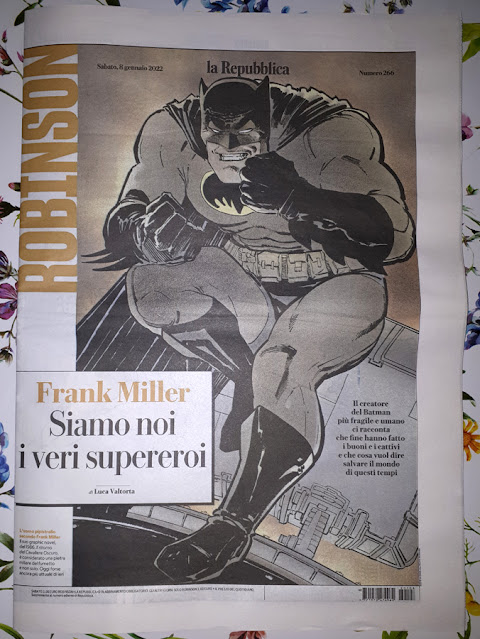
Luca Valtorta: What do you think about Alan Moore's statement that "superhero movies made for grown-ups are grotesque". [smoky note: I think the exact statement is a bit different. Moore said: "I have no interest in superheroes, they were a thing that was invented in the late 1930s for children, and they are perfectly good as children’s entertainment. But if you try to make them for the adult world then I think it becomes kind of grotesque." Source: Deadline]
Frank Miller: I have no comment, really. I don't like generalizations. I wouldn't say "westerns are bad movies". I am sorry but I am a bit more liberal than Alan.
Did you ever meet him in person?
Yes, we know each other pretty well. We disagree on many things but this has never been an obstacle to have a good time together.
Lately he has disappeared...
Yes, he doesn't like to get around that much but we all have tough moments...
Moore has declared himself an anarchist. And you?
I am a libertarian.
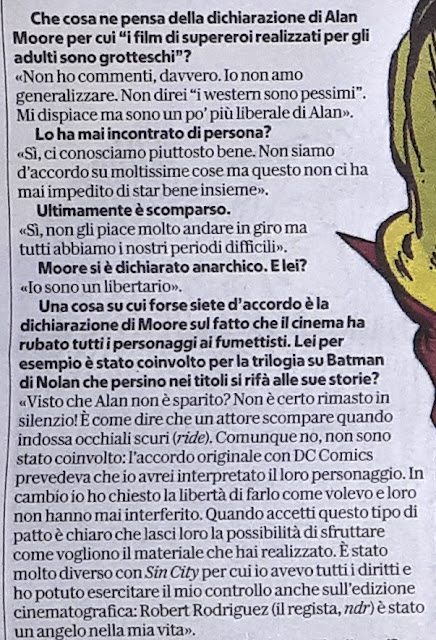
Maybe Moore and you agree on his declaration that movies have stolen all the characters from the comic book authors. For example, you have been involved in Nolan's Batman trilogy which references your stories even in the titles...
You see? Alan hasn't really disappeared! For sure he hasn't remained silent! This is like saying that an actor disappears if he wear sunglasses [Miller laughs].
Anyway I didn't get involved in Nolan's movies. [...]
 |
| Art by Nightgrowler |
 |
| Art by Eddie Campbell |
[...] What Eddie and Alan do have in common is an eagerness to expand the concerns of the 'comic' strip, whether in the big-bucks industry or through the small press scene. They spent the lunchtime drinking and talking. The subject of food didn't come up until last orders, when they adjourned for, as Alan put it, 'Pancakes with the Popular!'
[...]
Eddie Campbell: On Swamp Thing and others, you're working on raw material that's supplied to you. My stories are found, not constructed. You construct your stories almost along the lines of a song, in verse, rhythmic repetitions, all song devices.
Alan Moore: Yes, I work on a page length.
E: The page as your basic unit, the stanza. I'm finding a more organic shape, like a twisted branch, which is a form. You wrote in a review that 'Eddie doesn't write stories as such.' What do you think of as a story?
A: I've got a broad definition of the term story. What I meant was that to an audience weaned on average comics, you would not be writing stories. Now I can see it as a story, but to them the average comic is a continuum made up of lots of little episodes all strung together. You've got your own continuum, but you look at it differently, one single hour, one single day, out of the middle of it and you study it and suddenly you can see all the patterns that emerge in it. What both of us have in common is that we approach comics not just with a visual but with a literary sensibility. I can see that in your stuff and I know you do it consciously. What's come to constitute a story in comics is one where it's formularised, you set up the characters on the first page, the conflict round about the third page and when the conflict has resolved, the story's over.
E: I feel it's wrong to try to define the comic strip in formal terms. Comics are very much a tradition.
A: Oh yes, once comics encompassed a vast range of things, but we've deliberately limited our own field, hamstrung it. The superhero is an aberration, he's a jerk. He should never have been allowed to dominate the field. It's starting to change, but when you think of the tyranny of the superhero, you realise there are a lot of comic forms that are rarely explored anymore today.
E: Remember Rube Goldberg's delightful inventions? Isn't this idea of comics being 'sequential narrative' very limiting if we've got to exclude things like that?
A: But that happens with anything once you've got it rigidly defined. Years ago nobody knew what comics were, so they just did what they wanted. Imagine if George Herriman had ever read How To Draw Comics The Marvel Way, he'd be told he got his backgrounds wrong in 'Krazy Kat' because they weren't consistent! Once you create a rule, it's there to be ignored.
[...]
E: The terrible thing is that when you're looking for stories, life becomes fiction, stories happen because you were looking for them.
A: Well I'll tell you what I saw today. It's partly because I've started giving up smoking, so I've got that low nicotine jangliness which makes you perceive the world as a very strange place. I was standing at Lewisham station, looking down from the hill at this grim industrial cluster of prefabricated buildings with all these caravans parked on this grey asphalt stretch of land. Playing around the caravans were about ten young children, all of them looked cold and scruffy, and about fifteen dogs. This really strange little land of children and dogs, no adults to be seen anywhere. That struck me. I could probably come up with a story about it, but I can't work it into Swamp Thing.
E: It seems terrible to me that we're always stuck with melodrama. Why have comics always been melodramatic? There are stories in abundance, everywhere I looked I see something I want to record.
A: We mentioned the literary side of comics and it's a good comparison, because with literature the range of stories open to you is infinite. Whereas, if you want to make a living in the comics industry, you've got to write something on the level of 'Bulldog Drummond'.
E: I don't agree, we've got to expand it.
A: Oh yes. We're probably approaching the same problem from different ends. In my better stuff I'm trying to expand the concerns of what can or can't be done in mainstream comics. Nothing radical, but 'V for Vendetta', 'Bojeffries' and the odd page in Swamp Thing tread on new territory, even if it is still within the same basic structure. You're coming at it from totally outside the established comics field, just going out there to stake some territory. Hopefully we can meet . . .
E: Out on the perimeter, you mean! Another difference between us is that you're employed to do something, whereas I find myself urged to do something.
A: Yes, that's right. And I'm getting really bored with it.
E: I'm sure you could work my way.
A: Yes, I could. I'm really envious of your stuff - I have been for a while.
E: I'm envious of the money you're making!
A: I don't think I'm that envious of your stuff that I'd swap it for the money I'm making! I'm making what I call silly money, just from Swamp Thing alone. I've bought my Dad a greenhouse and my Mum an electric organ - I'm a big softy! There's too much money in American comics at the moment, it encourages greediness. It's a big temptation but I don't, because I'm a man of iron too! Ater I read 'Alec', I felt cheerier than when I started, uplifted to a minor degree. When I read my stuff, I come to the conclusion that I intended to do emotional or intellectual violence to the reader! It's very grim and nasty.
E: It's hard-bitten.
A: That's it. I just wish I could loosen my sphincter a bit! I wish I could do something that would make people feel good! I'm actually a very optimistic person, but obviously there's a lot of real black shit that needs to be worked out!
E: I think the reader gets the impression that I might be a nicer man to meet!
A: I think that's probably true!
[...]
E: [...] Do you think of comics as condensed films?
A: No, I try to question the instant assumption that films are comics' closest relative. To me it's a literary thing; not purely, there's the visual side as well.
E: I see the root of comics as the cartoon. I try to have each frame as an autonomous cartoon.
A: I can see that. In every shot you've got the entire bar and you can see all the characters. You don't give Danny Grey a close-up when he's saying something clever. That's a lot closer to the newspaper style of cartooning. You've made a true point but you've made a language that is eminently suitable for your sort of strips. You have to change the basic language of comics before you can change the content.
E: Yeah. I find in the wake of Escape, there's a lot of people trying to do the found story, overheard conversations, observations of life. So they're aware of a trend towards more sensitive comics, but many of them are still using the language of melodrama.
A: What I'm interested in is the creative process itself. I never get asked about that. But it's the most difficult thing to talk about, because the only language you can use is comics or music or whatever art you are doing, it's difficult to talk about all the tiny invisible decisions going on in your subconscious.
[...]
A: Theoretically if someone could use comics right, you could have a form of art that was more affecting than films or novels, if you could get that juxtaposition of word and image, so that you're striking all the chords. This is one thing I like about your stuff and which I try to emulate to a degree. If you give the reader a complete parcel of a neat plot, neat elliptical dialogue that all ties up neatly into a neatly resolved story, there's nothing left for the reader to digest, it's just something to swallow and shit. It'll taste nice on the way down but has no nutritional value whatever. The story should occur not on the page but five minutes later in the reader's mind. The best books I've read often have some line or scene that will be gnawing at the back of my mind for months. What did he mean? What was he trying to say? Thomas Pynchon's 'Gravity's Rainbow' has so much of that, every page has got one of those on it.
E: There's a sense of meaning rather than a statement.
A: Yeah, meaning is redundant, a meaning is a statement which is not a very interesting thing to make because it's dead, it's flat, it doesn't do anything. I mean 'War is Hell', it doesn't grow, whereas 'War is Fast Food', then people think 'What does he mean?' and they might actually take a week trying to figure it out. As it happens readers, it doesn't mean anything! But if there is that obliqueness to things, then it involves the audience, drags them in.
[...]
E: How do you feel about being considered a celebrity?
A: I know it's a bit wingey and whiny but sometimes I wish I didn't get quite the scrutiny that I do. When I started out writing, nobody expected me to be any good, so any good stories I did were seen as being really miraculous. But now if I do a story that's average or dull, then I'm sure most people see it as the beginning of the end. In that respect the relationship between the reader and the artist gets a bit twisted. It's no longer straight communication. It's probably something you've got to put up with.
E: But would you have been happier to remain in anonymity as Curt Vile?
A: Probably not and that just exposes my basic dishonesty! I may bitch about all this, but there is something wrong with the medium at the moment. If there were more good strip creators around, there wouldn't be so much unhealthy importance attached to personalities like Frank Miller or on one level me and on another you. There wouldn't be that Messianic glee and fervour and people would be able to look at the work more honestly and judge it independently of the hype surrounding it.
E: I think that's unavoidable, that's human nature.
A: But it's not the same in literature.
E: But it's not so exciting is it?
A: No. It's the youth of the audience that makes what we're doing closer to pop music. Popular culture.
E: Then you have to accept that this is the way it's got to go.
A: Yes, we can be teen idols!

 |
| Iain Sinclair and Alan Moore, 2017 |
Regime change in Whitechapel
Back in the dog days of the last century, before the restaurants in Brick Lane featured celebrity snaps of Prince Charles and a few dejected English cricketers on the piss and somebody in suit and tie who used to read the news (Falklands, Gulf War), a bunch of cultural subversives were gathered to enact, in their own ways, the last rites. The skeletal book-burner John Latham with his mad eyes and posthumous (slow, deadly) voice. Derek Raymond, jaunty, spry, fruity, smart, remembering what it had been like to be Robin Cook - and writing a cod-Bond novel that went so far off the rails that it froze time, a period in the Sixties, and entered all the dictionaries of slang. Poet and performance artist Brian Catling, shaven-headed, cigar-chomping, berobed, returning to scenes of vision and poverty, labours in the ullage cellar of Truman’s Brewery. Alexander Baron, solid but tentative, white raincoat like the negative of a lost life; post-war wanderings through a blasted landscape. And fellow Jewish memory-man, Emanuel Litvinoff, who once discussed alchemical epics with Elias Canetti. A few villains were also present: Tony Lambrianou, chauffeur to the rug-wrapped corpse of Jack the Hat, and the now vanished biblio-maniac Driffield. Then there was Alan Moore.
The excuse was a film for Channel 4, The Cardinal and the Corpse - which suffered from too many cardinals and not enough corpses (the dead wouldn’t lie down). Of all the faces who had to hang around, in Cheshire Street market, in the house with the peeling pink door in Princelet Street (now a regular feature in Dickens heritage romps), in the infamous Carpenters Arms (with its lost apostrophe), only one registered with the citizens, ordinary dishonest folk going about their business. ‘Are you,’ they challenged, not daring to believe it, ‘Alan Moore?’
Alan doesn’t quite believe it himself: that he is on set, grounded in the future of a definitively erased past, space-time anomalies he will activate in his serial composition, From Hell. This grimoire, with its fearsome apparatus of actual and fantastic scholarship, is the ultimate book on the Whitechapel Murders. The endstop. Many, many others, hacks, snoops, chancers, will follow - but they won’t register. Game over. Patricia Cornwell, the latest, richest, and most absurd, brings the weight (humourless, pan-global paranoia) of the CIA, forensic SWAT teams, art dealers, foot-in-the-door men to bear on a series of terrible Victorian crimes. She is the wrong book, straddled across the razor-wire of the genre fence. It’s like Miss Marple hitting Los Angeles to solve a slasher crime, the slaying of James Ellroy’s mother. Wrong game, wrong century.
Not content with world domination, America wants to invade the only thing we have left: the past. They devoured From Hell. They liked it and they bought the company. And made it into a ‘ghetto story.’ With punch, panache, zizz: the stuff they do so well. And with a brutal disregard for history, so that the pain (which burns through those stones still) of the butchering of Marie Jeanette Kelly is demeaned - by a narrative twist, wrong girl, and a happy John Ford ending in a whitewashed cottage in the west of Ireland.
Alan Moore knows that these sentiments can be floated as recalled potentialities, a single flash-frame in a dying consciousness, before the darkness sets in. One bead of bright light before an eternity of stygian black.
Loping down Princelet Street, with a kind of nautical roll, non-metropolitan - backlit Durer hair - Alan stands out; not belonging to these alleys and rat runs, he is visible in ways the other writers are not. The space between what he writes and what he is dissolves. He acts. The rest of them are what they do, talk, words - or quiet moments, caught at a window, of wounded reverie. There is a thing that won’t leave them alone, a vulture on the shoulder. ‘The general contract,’ Derek Raymond called it. Mortality.
Mortality imprints these streets like a miasma. Alan Moore, playing at the ‘discovery’ of a magical primer, plays at being trapped forever in this house, this place. And so it is. The Vessels of Wrath sail through the sky, clouds pierced by the steeple of Nicholas Hawksmoor’s Christ Church. The extraordinary, hallucinogenic structure that has haunted artists and writers (from Leon Kossoff to Peter Ackroyd) catches Alan’s eye: a stone needle in a pane of dirty glass. The church, with its balanced weight and mass, marries disparate elements: Greek, Roman, Gothic. As Moore will balance the unwieldy mass of dark history, lies, forgeries, echoes of other writers, Blakean epiphany, Crowley ritual.
There are no accidents here. Moore, on the steps of the church, is passing through, gathering what he needs. The rough walkers, the vagrants, the invisibles who challenge him, are there for the duration; no parole. Shifting facades, fresh scams; nothing changes.
Iain Sinclair
 |
| Art by Simon Bisley |
 |
| Art by Simon Bisley |
Marvel.com: I've heard some rumors about where the number 616 may have come from. But I want you to explain, definitively, where that number came from.
David Thorpe: Well, for years, I'd [gotten] emails from fans who say, “Why did you come up with 616?” And to be honest, I gave them each a different story. But, obviously, it's got something to do with 666, the number of the beast: 666 minus 50.
A nice, round number away from the scariest one.
David Thorpe: Yeah. Alan Moore, who took over the series, he was the one who actually put it into print. Let's be fair. And both Alan and I shared a big interest in magick and the occult. And I got into chaos magick, and then I think Alan did, and so did Grant Morrison and quite a few of us, you know, in the comic scene at that time in the '80s.
 |
| Art by Simon Bisley |
George Khoury: [...] you were going to do this book originally with Simon Bisley?
Alan Moore: Originally, I’d put the idea forward without an artist attached to it, to Kevin Eastman, I think. And at that point, I think Kevin Eastman had advanced me some money on the understanding that I would do a 64-page graphic novel for him at some point. And he wanted me to work with Simon Bisley. So that was the original idea, that we’d perhaps put together this League of Extraordinary Gentlemen thing.
But then I think I got a phone call from Kevin saying that he didn’t want me to do the graphic novel with Simon Bisley, he’d rather that I’d work off his advance by doing the Spirit stories for the Spirit comic that he was going to be bringing out. So I did those for that first issue of The Spirit with Dave Gibbons, which was great fun. So the other stuff never happened with Simon Bisley, and the idea was still around.
Then when I started thinking about it seriously, Kevin O’Neill was the artist that was right at the forefront of my mind. It just seemed, once I thought of Kevin, he seemed to be the perfect artist. He would allow the strip to evolve in a completely different way. Kevin’s work is meticulous, but there is an exaggerated and cartoony quality, which is part of its genius. And that kind of almost cartoony flexibility allows you a much greater emotional range in the strip. With The League of Extraordinary Gentlemen, partly because of Kevin’s art, we can span comedy, horror, and pathos in a couple of pages. Often in one page, sometimes in one panel. The emotional range that Kevin’s artwork lends to the story is fantastic. It’s one of the main assets of The League. There’s some scenes in there which are going to be horrible, silly, and all sorts of other things. Quite erudite, intelligent. It’s an interesting mix that we can get away with, regarding The League.

